
Annual Advanced Meeting in Veterinary Homeopathy
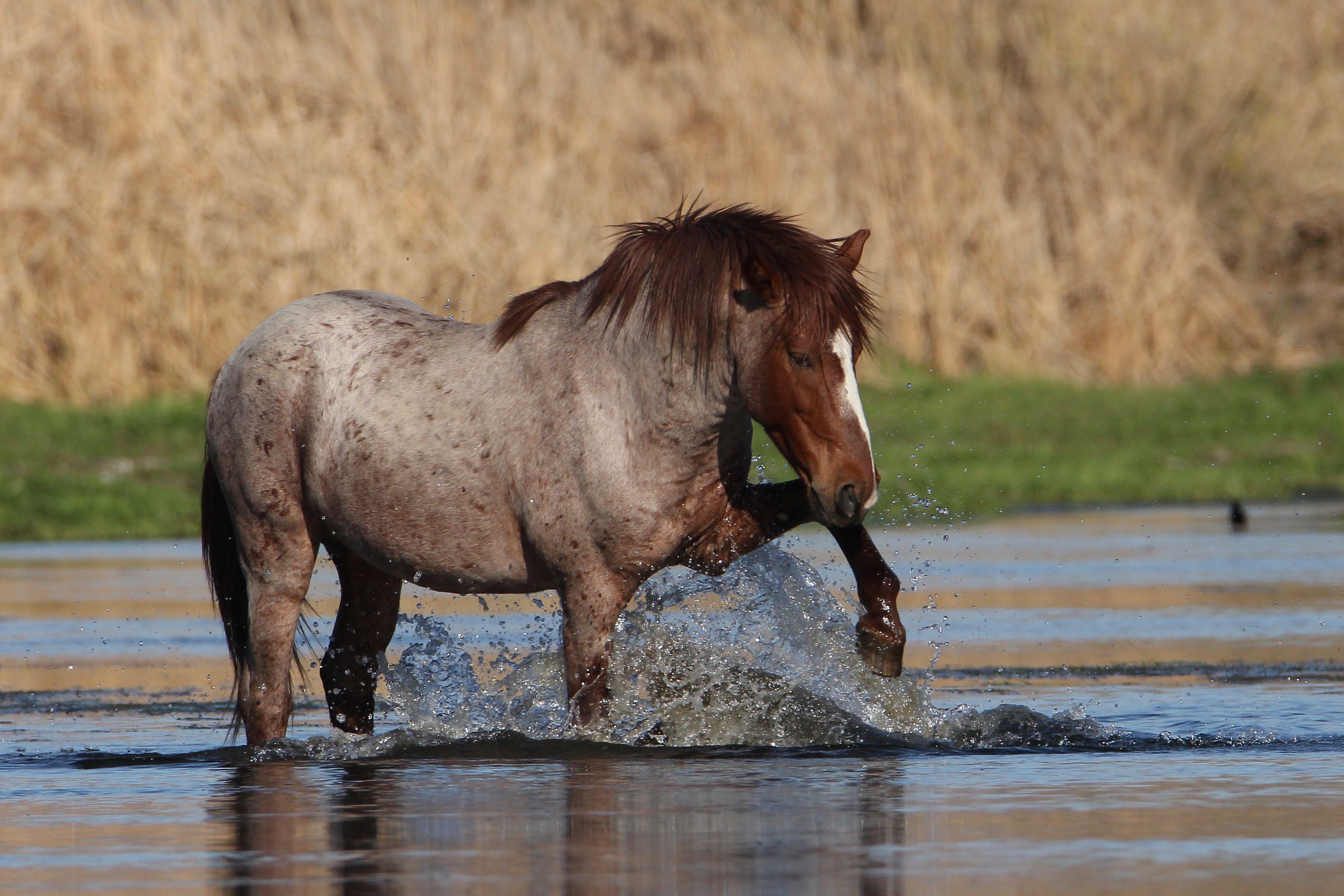
Photo taken of a wild stallion in the Salt River near the ranch, curtesy of Jan Facinelli, DVM.
The PIVH Annual Advanced Meeting in Veterinary Homeopathy 2026
Wednesday, February 18th – Sunday, February 22nd, 2026
Conference Theme: Learning from Unusual Cases
In next year’s conference, our meeting’s theme ‘Learning From Unusual Cases’ broadens our perspective in our clinical case work. This can apply to learning new aspects of familiar remedies, deepening our understanding of less frequently used remedies in our arsenal, or observing unusual symptoms or “strange, rare, peculiar” (SRP’s) – all which enlarge our view of what particular remedies are capable of addressing. Several talks this year will also include delving into the realm AI, demonstrating the possible considerations of how it can intersect in our case work. We will draw from our own cases or from the literature. The focus will be on cured clinical cases, but may also present theory or discussion from our historical masters.
Registration will open in fall of 2025 — check back for speaker topics and registration link as they come available! As always, presentations will vary from theory, materia medica and repertory study, to exciting cured clinical cases.
This year we will continue our traditional three and a half day main conference format from Thursday February 19th through Sunday February 22nd, with the popular extended lunch breaks for relaxation and recreation (hiking, swimming, etc.). We invite you to attend our additional ‘Optional Day’ on Wednesday February 18th to start off the conference, beginning with a day of interactive study and discussion moderated by Richard Pitcairn, DVM, PhD.
The Annual Meeting is routinely held in February at the Saguaro Lake Ranch in the mountains outside of Phoenix, AZ. This beautiful location provides an excellent opportunity for focused study, catching up with friends and classmates, relaxation, hiking, swimming, and connecting with other veterinary homeopaths in the tranquil atmosphere of the Saguaro Lake Ranch. If desired, there is also the option of staying off-site and just attending the meeting and elected meals.
All meals are included with lodging and are served in a shared dining style, providing exceptional fare and a health conscious retreat to rejuvenate both body and mind. The menu is predominantly a vegan menu to bring a focus on healthy, environmentally sensitive, and compassionate foods. Please fill in the comment box on the registration form for any dietary requests you might have such as food allergies or any non-vegan requests.
Recordings now available! 2025 Annual Advanced Meeting in Veterinary Homeopathy
Purchase of the 2025 meeting recordings includes a PDF file of the Conference Proceedings. Content for the 2025 meeting can be viewed below. If you are interested in the Audio Recordings and the Conference Proceedings of any of our prior Annual Advanced Meetings (2000 – 2024) – please contact info@pivh.org.
The 23rd PIVH Annual Advanced Meeting in Veterinary Homeopathy: February 26th – March 2nd, 2025
Conference Theme: Harvesting the Materia Medica: Gathering the Experience of Outstanding Homeopaths
We would like to extend a big THANK YOU to all of our attendees for joining us; to our speakers for all their hard work – Andrea Tasi, Corine Selders, Jane Laura Doyle, Madalyn Ward, Todd Cooney, Richard Pitcairn, and Wendy Jensen; and to our dedicated conference committee. Our 2025 meeting’s theme ‘Harvesting the Materia Medica: Gathering the Experience of Outstanding Homeopaths’ brought the focus of the presentations on deepening our understanding of the Materia Medica – through a variety of presentations, including exciting cured clinical cases bringing the materia medica to life!
2025 Meeting Content: Presentation Topics & Abstracts
There are 15 hours of presentations with CE credit, with six of the presentations during the four days by Richard Pitcairn and nine hours by other speakers. Preview the speakers, presentation topics, and abstracts below:
Less Known Remedies
Interesting cases from Elizabeth Wright Hubbard, MD who practiced in New York in the early 1900’s. Emphasis on remedies we are not as familiar with.
— Richard Pitcairn, DVM, PhD


The Remedy Calc-phos in Horses
For this presentation, I will present a picture of the remedy Calc-phos and its use in horses. I will offer several cases where Calc-phos played a role in clearing chronic symptoms and improving the overall well-being of the horse. Calc-phos is a remedy that is often considered for bone development and fracture repair. While Calc-phos is wonderful for these situations it is also very useful as a deep-acting remedy to cover a wide range of chronic disease symptoms.
— Madalyn Ward, DVM
Use of the Calvin Knerr Repertory
This is a very useful repertory for prescribing on animals. It is derived from Hering’s Guiding Symptoms, and has much detail on the physical expressions of disease. As an example, we will compare the rubrics for suppuration and pus in the Calvin Knerr repertory with the Boenninghausen and Kent repertories and see how much more information Knerr gives us.
— Richard Pitcairn, DVM, PhD

What Happens After the Cough? A Differential Study of An Aggravation Rubric
There are 15 remedies in the New World Vet Rep rubric Generalities; Agg.; Coughing; After. We will discuss how the reaction to a coughing fit differs among these remedies. How can the practitioner determine aggravation after coughing? How exactly does the patient react? What might help the patient feel better? What concomitant symptoms are more common in each remedy? We will take a tour of these remedies and leave with a better understanding of each medicine’s place in the treatment of a coughing patient.
— Wendy Jensen, DVM, CVH
Cases from Erastus Case, MD (1847-1918)
The cases from this practitioner are very useful for learning guiding symptoms of remedies. They are brief cases he had organized as a learning tool, The intention was to recognize guiding symptoms that would identify the remedy that was curative.
— Richard Pitcairn, DVM, PhD

Curability of Tumors by Homeopathic Medicines — Thoughts on J. Compton Burnett’s Work
For this presentation: I love to read the older homeopathic literature to get insight into their world, and how they approached cases. Burnett is a favorite, as I mentioned a few years ago, presenting thoughts on ‘Fifty Reasons for being a Homeopath.’ In this little book, the good doctor presents a case for going beyond the totality of symptoms when choosing a remedy to treat tumors, to avoid palliation and really achieving a cure in these most difficult cases. Journey back to the late 1800s with me, sit with him for awhile, and hear his thoughts about remedy selection, and several amazing cases he reports.
— Todd Cooney, DVM, CVH
More Erastus Cases
These are more cases from Erastus Case, ones that include enough information we can practice finding the remedy in the repertory and materia medica.
— Richard Pitcairn, DVM, PhD

The pony with a mysterious illness.
Cammie is a 30 year old Welsh grey pony mare that survived a life threatening acute illness due to fortitude, collegiate collaboration and support, and faith in homeopathy. She began with an acute fever and malaise of unknown origin, that developed into life threatening abscessation due to comprised upper airway obstruction. As allopathic medicine failed, the diagnosis was unclear, and the risk of losing the patient was at stake, classical homeopathic treatment was commenced. Radiographs, blood work, ultrasound aid the internal medicine adventure and document the cure. This case is a study a deep abscess remedies, and a lesson in careful prescribing, when to “watch & wait” and when to repeat using multiple daily assessments, and carefully changing the remedies as her case and symptoms changed.
— Corine Selders, DVM
Sarcoma in a Child
A very interesting and informative case, from 1902, of the treatment of a three-year-old girl with sarcoma who had been suppressively treated, predicted to die, and yet cured with homeopathy.
— Richard Pitcairn, DVM, PhD

The Wild Range of Arsenicum Album
Arsenicum album still surprises me after all these years. When I was a new homeopath, I initially thought of it for gastrointestinal problems and had great successes. Then with progression of my studies, I discovered its application in respiratory disease, followed by successes in renal disease. With broadening materia medica study, I have come to appreciate its depth which goes beyond the classic character types of the remedy. It continues to pop up in my analyses when the seat of disease is somewhere I don’t expect to see it. I will discuss its wide range of applications, including materia medica study as well as cases from my practice.
— Jane Laura Doyle, DVM
Homeopathy for Euthanasia
Some cases are not curable as the patient is very close to dying. Using the symptoms, it is possible to find a remedy can be used to make the process easy and without discomfort. We look at example cases.
— Richard Pitcairn, DVM, PhD

Fungus Among Us: A Homeopathic Approach to Feline Dermatophytosis
We will look at a common “infectious” disease using repertory and materia medica study, with case examples of different presentations of “ringworm” patients from my feline only practice. Repertory study will review terminology/rubrics used to describe this condition, and we will create “genus epidemicus” type analyses from both the Kent and Boger-Boenninghausen repertories. Materia medica will review the nature and comparison of remedies that make the most sense to consider in cases of feline ringworm. Case examples will emphasize understanding individual susceptibility and direction of cure. In addition, we will discuss that just because a disease is potentially zoonotic, we do not have to be fearful or abandon our homeopathic principles! Remember: you can’t spell fungus without F*U*N!! And there are pictures of kittens!!)
— Andrea Tasi, VMD
Book review: The Mercury Visions of Louis Daguerre by Dominic Smith
In this novel, Smith covers Daguerre’s life, from his unhealthy childhood, through his careers in adulthood, and the toxic effects of the mercury he used in his invention of photography. Photography was my first love, so when I found this book in a large bookstore chain’s bargain bin, I grabbed it up. I will discuss the book and delve into materia medica of Mercurius, comparing Smith’s quasi-nonfiction with the remedy.
— Jane Laura Doyle, DVM

Each year the conference features lectures by Dr. Richard Pitcairn, PIVH faculty, and a selection of guest speakers. Topics vary from year to year but include theory, case study, and practice management specific to the homeopathic veterinary practice.